This how-to guide on drug dosage calculations has been created for student nurses, nurses, pharmacy students, trainee pharmacists and pharmacy technicians. This guide aims to teach you how to calculate a drug dosage from its stock strength.
This learning is divided into three parts.
- Part 1 will define the two drug dosage calculation formulas that can be used to calculate the required drug dose from stock strength for both oral tablets/capsules and oral liquid medicines.
- In part 2, you will find drug calculation examples (with detailed steps) on how to calculate the required number of tablets or volume of liquid medicine.
- Finally, in part 3, you can test what you have learnt by attempting the drug calculation test questions.
Let us get started.
Drug Dosage Calculation Formulas – Part 1
To calculate the number of tablets, use the following drug dosage calculation formula:
Strength required / Stock strength = Number of tablet(s) requiredOr another way this drug dosage calculation formula can be expressed is:
What you want / What you’ve got = Number of tablet(s) requiredTo calculate the volume dose for a liquid medicine, use this drug dosage calculation formula:
(Strength required / Stock strength) × Stock volume = Volume dose requiredOr another way this drug dosage calculation formula for liquid medicines can be expressed is:
(What you want / What you’ve got) × What it’s in = Volume dose requiredThis drug dosage calculation formula can also be used to calculate the volume dose required for injections.
Drug Calculation Examples (With Steps on How to Calculate a Drug Dose) – Part 2
Before working through these drug calculation examples and attempting the drug calculation test questions in the next part, remember to ensure the strength required and stock strength are always in the same units of measure (i.e., both ng, both mcg, both mg or both g). If you are unsure how to convert from one unit of measurement to another, take a look at the conversion between units of measure tables for mass and volume on our sister website; in addition, practice converting from one unit of measurement to another by attempting the units of measurement drug calculations quiz.
How to calculate the number of tablets required
Example:
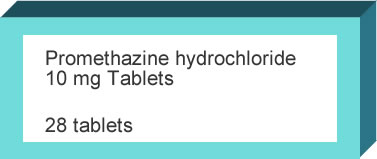
The doctor prescribes promethazine hydrochloride 20 mg for patient X. The available stock strength you have is 10 mg. How many tablets are required?
Step 1
- The strength required (what you want): 20 mg
- Stock strength (what you’ve got): 10 mg in one tablet
Step 2
- 20 mg / 10 mg = 2 tablets
- Answer: 2 tablets are required
Example:
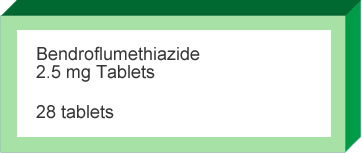
The doctor prescribes bendroflumethiazide 7.5 mg on patient X’s drug chart. How many tablets should the nurse administer to patient X if the available stock strength on the ward is 2.5 mg?
Step 1:
- The strength required: 7.5 mg
- Stock strength: 2.5 mg
Step 2
- 7.5 mg / 2.5 mg = 3 tablets
- Answer: 3 tablets are required
Example:
The doctor prescribes levothyroxine 0.2 mg on patient X’s drug chart. How many tablets should the nurse administer to patient X if the available stock strength on the ward is 100 mcg.
Step 1:
- The strength required: 0.2 mg
- Stock strength: 100 mcg

Step 2:
- Convert the strength required from mg to mcg so that the units of measurement are the same: 0.2 mg x 1000 = 200 mcg
Step 3:
- 200 mcg / 100 mcg = 2 tablets
- Answer: 2 tablets are required
Example:
The doctor prescribes bisoprolol 5 mg on patient X’s drug chart. How many tablets should the nurse administer to patient X if the available stock strength on the ward is 1.25 mg.
Step 1:
- The strength required: 5 mg
- Stock strength: 1.25 mg

Step 2:
- 5 mg / 1.25 mg = 4 tablets
- Answer: 4 tablets are required
How to calculate a liquid medication dosage
Example:
A patient requires amisulpride 200 mg. The available stock on the ward is 100 mg/mL (100 mg in 1 mL) oral solution. What volume is required?
Step 1:
- The strength required (what you want): 200 mg
- Stock strength (what you’ve got): 100 mg
- Stock volume (what it’s in): 1 mL

Step 2:
- (200 mg / 100 mg) x 1 mL = 2mL
- Answer: 2 mL is required
Example:
A patient requires dihydrocodeine 30 mg. The available stock on the ward is 10 mg/5 mL (10 mg in 5 mL) elixir. What volume is required?
Step 1:
- Strength required: 30 mg
- Stock strength: 10 mg
- Stock volume: 5 mL

Step 2:
- (30 mg / 10 mg) x 5 mL = 15 mL
- Answer: 15 mL is required
Example:
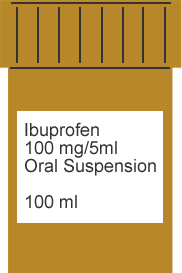
A patient requires ibuprofen 0.3 g. The available stock on the ward is 100 mg/5 mL (100 mg in 5 mL) oral suspension. What volume is required?
Step 1:
- Strength required: 0.3 g
- Stock strength: 100 mg
- Stock volume: 5 mL
Step 2:
- Convert the strength required from g to mg so that the units of measurement are the same: 0.3 g x 1000 = 300 mg
Step 3:
- (300 mg / 100 mg) x 5 mL = 15 ml
- Answer: 15 mL is required
Example:
A patient requires morphine sulphate 7.5 mg. The available stock on the ward is 10 mg/5 mL (10 mg in 5 mL) oral solution. What volume is required?
Step 1:
- Strength required: 7.5 mg
- Stock strength: 10 mg
- Stock volume: 5 mL

Step 2:
- (7.5 mg / 10 mg) x 5 mL = 3.75 mL
- Answer: 3.75 mL is required
Drug Calculation Test Questions and Answers – Part 3
You can test what you have learned with these drug calculation test questions. There are ten drug dosage calculations to attempt; you will be able to check your answers when you have completed all of the questions.

Drug Calculation Tips
- Make sure the units of measure match
- Recheck your answer
- Ask a colleague to calculate the drug dosage as well
- Does the answer seem to be logical to you?
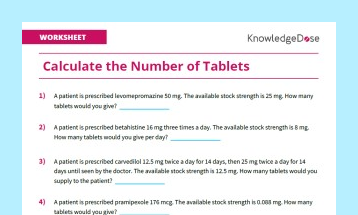
For further practice on drug dosage calculations, download the following worksheet: calculate the number of tablets to give the patient from a stock strength.